
Your company is in the market for an enterprise AI solution. But there are a lot of options. What features should you consider “must-haves?” One of them is Role-Based Access Control (RBAC).
In this video, I cover why Role-Based Access Control is a must have for your company.
Want my recommendations on the best Enterprise AI Solution to quote your company?

About Me

Mike Smith has been helping companies select the best telecom, WAN, security, and cloud services since 1999. He founded AeroCom in 2003, and has been the recipient of numerous business telecommunications industry awards, including being recognized as one of the top 40 business people in tech-heavy Orange County, CA. Follow Mike on YouTube, LinkedIn, Reddit and SpiceWorks.
Key Takeaway
Enterprise AI solutions must align with existing organizational security structures, and role based access control (RBAC) is one of the most critical features to evaluate. RBAC ensures users only access the data appropriate for their position, protects sensitive information, and reduces unnecessary IT configuration when integrated with systems like Microsoft Active Directory. Companies adopting enterprise AI at scale benefit from choosing solutions that seamlessly mirror internal permission models while supporting efficient, secure deployment.
Table of Contents
- The Importance of Role Based Access in Enterprise AI
- How RBAC Aligns With Internal Access Structures
- Integrating RBAC Through Microsoft Active Directory
- Why RBAC Should Be a Non-Negotiable Feature
Transcript
As organizations begin exploring enterprise AI solutions, it quickly becomes clear that there are many options available. With so much variety, identifying the must-have features becomes essential. One of the most important capabilities to look for is role based access. Role based access ensures your AI environment aligns with the way your internal teams already manage and restrict information. This helps maintain data integrity and keeps sensitive content protected while scaling AI across the company.
My Recommendation
First, however, if you’d like my book recommendations on the best enterprise AI solutions that your medium to large-sized company should be quoting, reach out, send me an email or give me a call (714.593.0011). Send me an email. Give me a call. Don’t try to figure this out on Google. It’s way too hard. There are too many vendors out there. You know, AI is huge, so a lot of vendors are throwing their hats in the market, and you want to know which ones you should quote. Well, reach out and contact me. Join the thousands of other IT professionals who have used me to make much better decisions in a fraction of the time for their companies. And the nice thing is, I don’t charge you anything for my services. I’ve been doing this for over 20 years, so I know the industry inside and out. I guarantee you it’s worth a call. You have no excuse since I don’t charge you anything. So send me an email, give me a call.
The Importance of Role Based Access in Enterprise AI
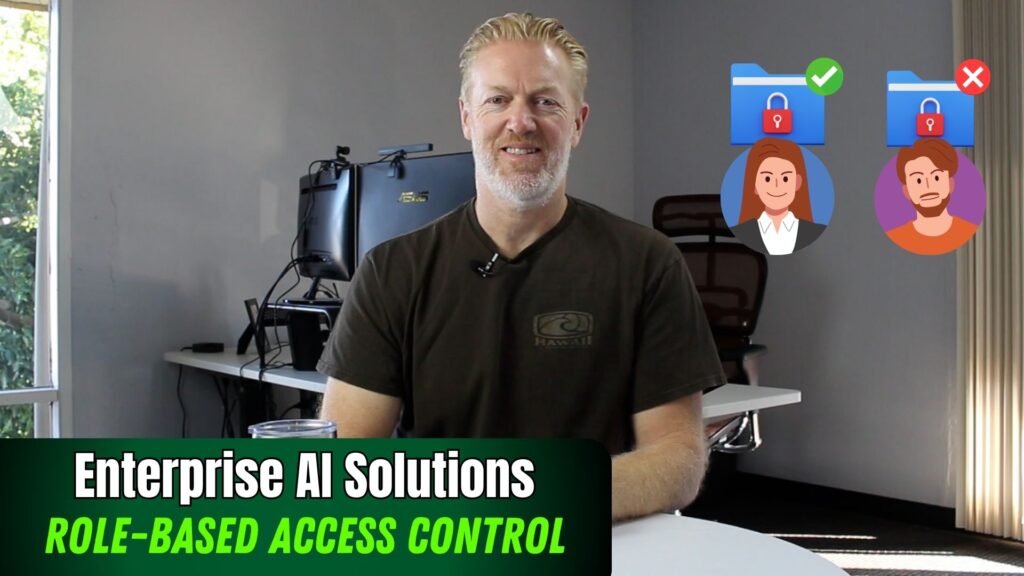
Role based access allows an AI system to limit what data it can query based on each user’s permissions. In any organization, executives naturally have more visibility into sensitive information compared to new hires. An enterprise AI solution should respect those same boundaries. Without role based access, the AI may surface information a user should not be able to see, making this feature critical for maintaining the confidentiality of HR, financial, and executive-level data.
How RBAC Aligns With Internal Access Structures
Most companies already maintain internal role structures that determine who can view what information. For example, your executive team may have access to detailed organizational data, while entry-level employees operate with restricted visibility. An enterprise AI solution should mirror these existing layers of access. When the AI queries information, it must do so only within the data a particular user is already allowed to access. This alignment keeps existing internal access policies intact and reduces business risk.
Integrating RBAC Through Microsoft Active Directory
The most efficient enterprise AI solutions allow role based access to be configured directly through Microsoft Active Directory. This ensures that the AI system automatically inherits the user roles you already have in place. By mimicking those Active Directory roles, the AI becomes far easier for IT teams to manage, requiring less manual configuration and reducing the chance of misaligned permissions. This integration streamlines deployment and simplifies ongoing administration as your organization scales its AI usage.
Why RBAC Should Be a Non-Negotiable Feature
For companies adopting enterprise AI—especially those planning to deploy 50 or more AI agents—role based access is essential. It ensures that sensitive information remains protected, maintains internal consistency, and minimizes risk. RBAC also improves operational efficiency by helping the AI deliver relevant, appropriate data to each user without exposing information beyond their access level. When evaluating vendors, role based access should be considered a must-have feature for any secure and scalable AI deployment.
Which Enterprise AI Solution should your company quote?
Choosing the right enterprise AI solution requires attention to both capability and security. Role based access offers a dependable way to safeguard organizational data while supporting efficient adoption across teams. By selecting AI platforms that integrate seamlessly with systems like Microsoft Active Directory, companies can ensure the AI environment reflects their established access policies. This creates a safer, more manageable, and better-aligned implementation as enterprise AI becomes an increasingly important part of internal operations. If you still have questions feel free to reach out, send me an email or give me a call (714.593.0011)
Related Content
 Enterprise AI: Single Sign On (SSO)
Your company is in the market for an enterprise AI solution. But there are a lot of options. What features […]
Enterprise AI: Single Sign On (SSO)
Your company is in the market for an enterprise AI solution. But there are a lot of options. What features […] Enterprise AI: 7 Features Your Company Needs
Your company is in the market for an enterprise AI solution. But there are a lot of options. What features […]
Enterprise AI: 7 Features Your Company Needs
Your company is in the market for an enterprise AI solution. But there are a lot of options. What features […] Enterprise AI: 5 Baby Steps
Your company is in the market for an enterprise AI solution. But it feels a little overwhelming. Where does […]
Enterprise AI: 5 Baby Steps
Your company is in the market for an enterprise AI solution. But it feels a little overwhelming. Where does […] The Best Call Center Software for Law Firms: 4 Must-Haves
Your law firm has a call center, and it's time to shop for new call center software. But what are the […]
The Best Call Center Software for Law Firms: 4 Must-Haves
Your law firm has a call center, and it's time to shop for new call center software. But what are the […] Large Business Phone System Comparison: Zoom Phone, Teams phone, and Cisco Webex
You work for a large company (hundreds or thousands of employees), and you're phone system is end of life… […]
Large Business Phone System Comparison: Zoom Phone, Teams phone, and Cisco Webex
You work for a large company (hundreds or thousands of employees), and you're phone system is end of life… […] How to Integrate Microsoft Teams Phone with call center software like Genesys, Five9, and NICE CXone
Your company is medium-large-size, and is in the market for a new phone system, and you're thinking Teams […]
How to Integrate Microsoft Teams Phone with call center software like Genesys, Five9, and NICE CXone
Your company is medium-large-size, and is in the market for a new phone system, and you're thinking Teams […]